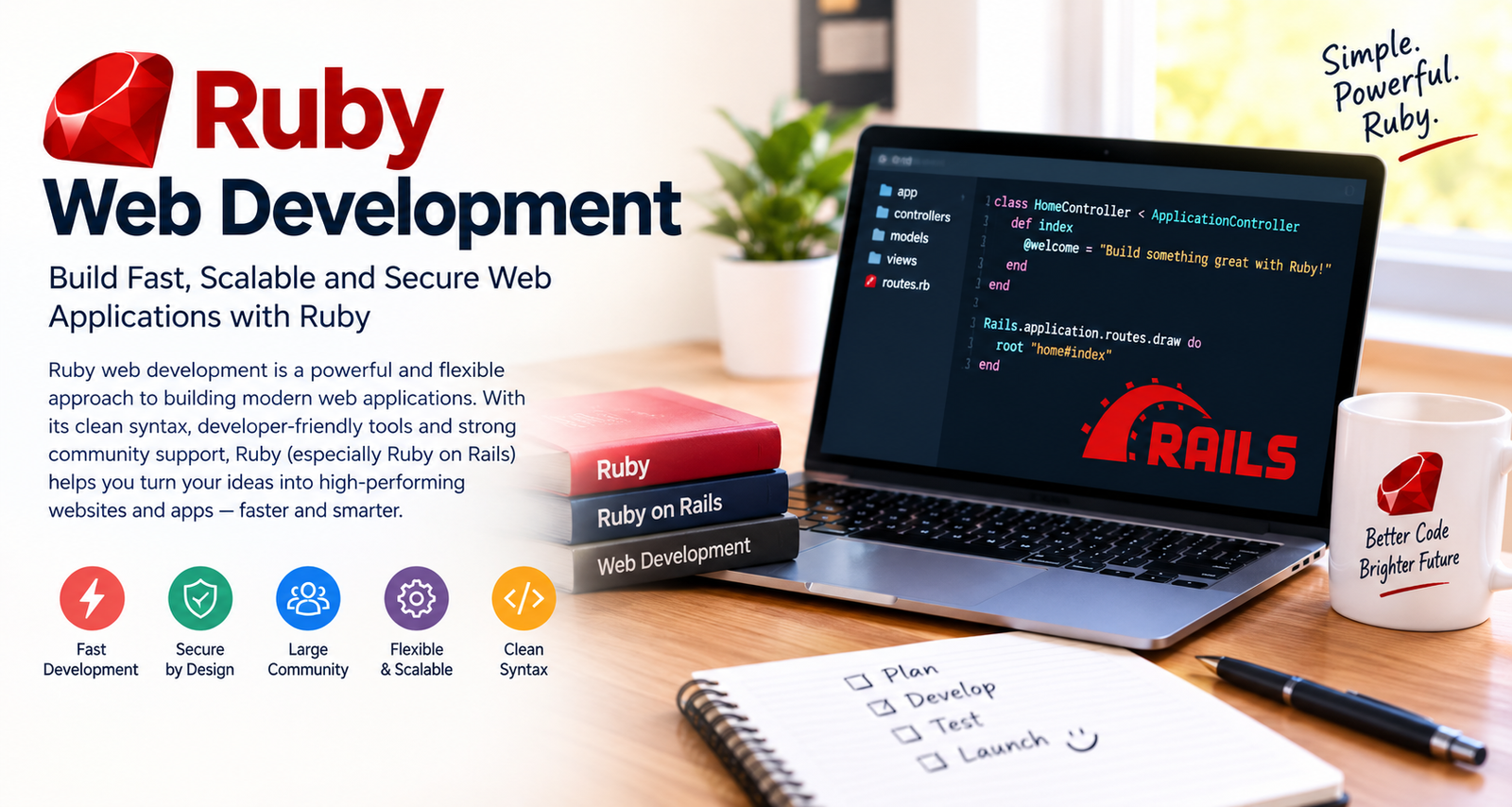
Building a website or web application is no longer about writing lines of code. Businesses need websites that’re fast and secure and easy to maintain and capable of growing as their audience grows. This is where Ruby web development continues to be a choice for developers and businesses.
Ruby is a programming language known for its syntax and developer-friendly approach. When combined with Ruby on Rails it provides a framework for creating everything from simple websites to complex web applications.
What Is Ruby Web Development?
Ruby web development refers to building websites and web applications using the Ruby programming language. Ruby is designed to make programming easier to read and understand, which allows developers to focus more on solving business problems than dealing with unnecessary complexity.
One of the popular technologies in this area is Ruby on Rails often simply called Rails. Rails provides developers with made tools, conventions and structures that can significantly speed up the development process.
Of building every feature from scratch developers can use Rails built-in approach to handle common tasks such as database management, routing, authentication, testing and application structure.
Why Choose Ruby for Web Development?
There are programming languages available today so it is reasonable to ask why a business should consider Ruby.
One major advantage is simplicity. Ruby code is generally designed to be readable making it easier for developers to understand and maintain projects.
Ruby also has an ecosystem and a large collection of libraries and tools. This means developers can often find existing solutions than reinventing the wheel.
Another important benefit is development speed. Ruby on Rails follows the principle of convention over configuration giving developers sensible defaults and reducing the amount of setup required.
Ruby on Rails for Modern Web Applications
Ruby on Rails development has been used to build different types of applications including business platforms, e-commerce websites, SaaS products, marketplaces and content-driven websites.
Rails follows the Model-View-Controller (MVC) architecture:
- Model: Handles data and business logic.
- View: Controls what users see.
- Controller: Connects user requests with the application logic.
This structure helps keep an application organised as it becomes larger.
For startups and businesses working with development time this organised approach can be particularly useful.
Key Benefits of Ruby Web Development
1. Faster Development
Ruby on Rails provides tools that simplify common development tasks. Developers can create application features without spending time on repetitive configuration.
This can help businesses move from an idea to a working product quickly.
2. Readable Code
Rubys syntax is one of its biggest strengths. Code tends to be relatively easy to read which can make collaboration and future maintenance simpler.
When several developers work on the project readable code can save valuable time.
3. Strong Community Support
Ruby has an established developer community and a large ecosystem of open-source libraries known as gems.
Developers can use these resources to add functionality solve problems and improve applications without developing every component independently.
4. Suitable for Startups
Startups often need to test ideas. Ruby on Rails is well suited to building viable products (MVPs) allowing teams to launch an initial version and improve it based on customer feedback.
This doesn’t mean Rails is for small projects. Designed Ruby applications can also support substantial and complex systems.
5. Maintainable Applications
Good development is not about launching an application. It is also about keeping it reliable over time.
Rails encourages an approach to development, testing and application organisation. This can make long-term maintenance easier when new developers join the project or new features are added.
Is Ruby Web Development Good for Businesses?
For businesses the answer can be yes.
The right technology depends on the type of project, budget, development team, performance requirements and future plans. Ruby can be an attractive option when a business wants to build a custom web application efficiently.
For example a company might use Ruby to develop:
- Customer management platforms
- SaaS applications
- Online marketplaces
- E-commerce platforms
- Booking systems
- Business dashboards
- Membership websites
- Internal business tools
- API-based applications
The important thing is not simply choosing a technology. The development team should select a technology that fits the requirements of the project.
Ruby Web Development vs Other Technologies
Ruby is not the option for modern web development. JavaScript, Python, PHP, Java and other technologies are widely used.
The biggest advantage of Ruby is often its developer experience. Ruby and Rails provide a structure and many conventions that help developers build applications without excessive configuration.
However every project is different. A development team should consider factors such as hosting requirements, available developers, integrations, expected traffic, application complexity and long-term maintenance before making a decision.
How Much Does Ruby Web Development Cost?
There is no price for a Ruby web development project.
The cost can depend on:
- Application size
- Number of features
- UI/UX requirements
- Database complexity
- Third-party integrations
- Developer experience
- Testing requirements
- Security requirements
- Ongoing maintenance
A basic business application may require less development time than a large SaaS platform with multiple user roles, payment systems, APIs, dashboards and advanced functionality.
For this reason businesses should define their requirements before requesting a development estimate.
Choosing a Ruby Web Development Company
If you plan to hire a Ruby development team don’t choose a company based on price.
Look at its projects, technical experience, communication process, development methodology and ability to provide ongoing support.
It is also worth asking how the team handles testing, security, deployment, backups, performance optimization and future updates.
A good development partner should understand your business goals than simply delivering code.
The Future of Ruby Web Development
Technology continues to change. Established programming languages can remain valuable when they have strong communities, mature frameworks and reliable development practices.
Ruby continues to be relevant for developers who value productivity, readable code and a structured approach to application development.
For businesses the real question should not be whether Ruby is the technology. Instead it should be whether Ruby can effectively solve the problem they are trying to solve.
In cases it can.
Final Thoughts
Ruby web development offers a way to create modern, scalable and maintainable web applications. Its clean programming style, mature ecosystem and powerful Rails framework make it an appealing option, for startups, established businesses and developers.
Whether you’re planning a SaaS platform, an online marketplace, a business portal or a custom web application Ruby can provide a solid foundation.
The best technology is ultimately the one that fits your projects goals, budget, users and future growth—. Ruby remains a strong option worth considering.